
Printable Bible study resource
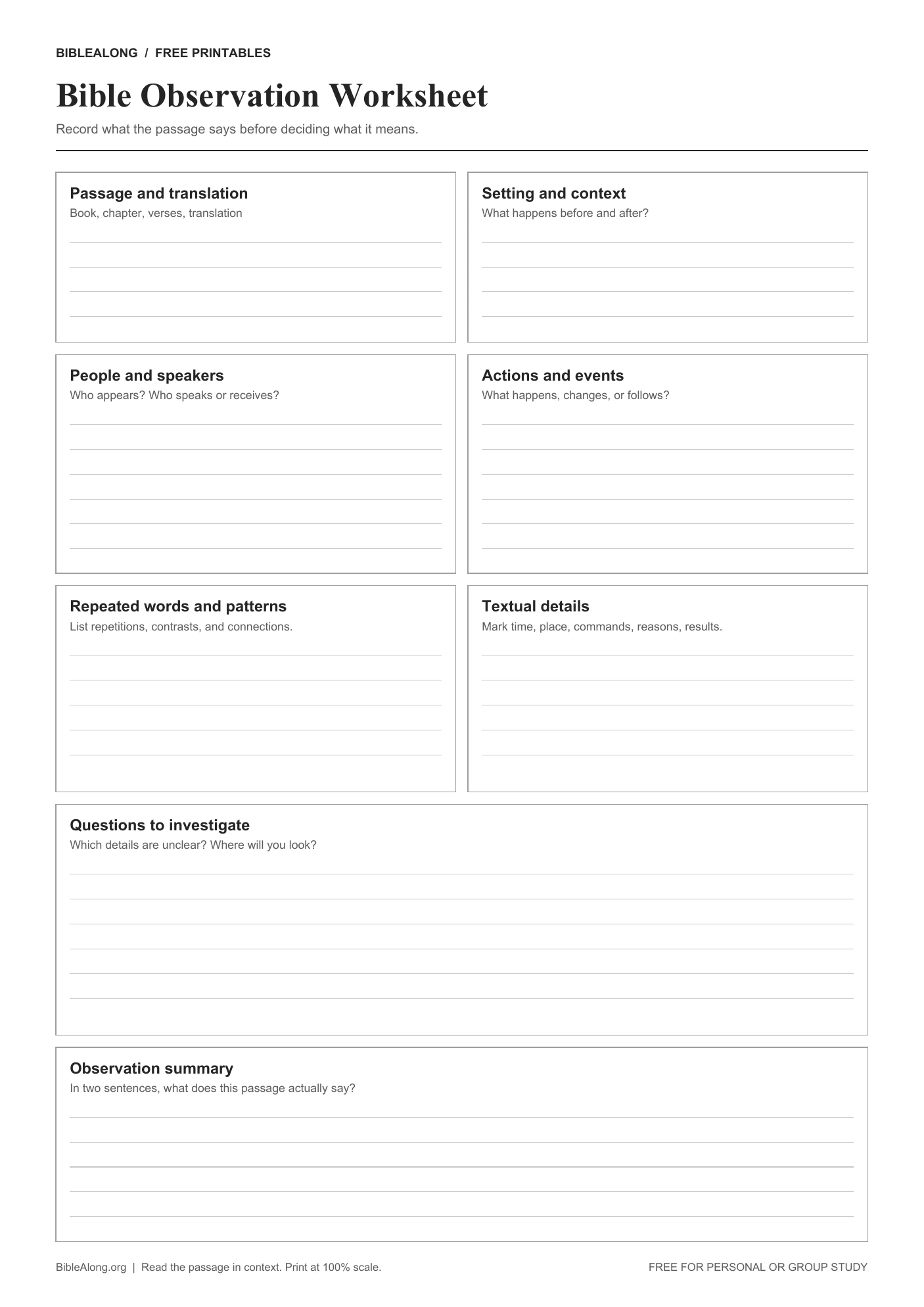
Bible Observation Worksheet
A focused worksheet for the first step of Bible study: noticing what the passage actually says.
Observation comes before interpretation. Read a complete scene or paragraph more than once, then record the details you can point to in the text. The dedicated boxes help you separate people and speakers, actions and events, repeated wording, nearby context, and questions. Finish with a short summary that describes the passage without importing conclusions from a commentary. For the next step—asking what the observations mean—use the inductive worksheet.
Free download · No signup required
How to use this worksheet
- 1
Read the passage and its neighbors
Write the reference and translation. Read what comes before and after; note where the paragraph or scene begins and ends.
- 2
List people, actions, and words
Record who speaks, what each person does, commands, outcomes, repeated expressions, and contrasts. Quote only the words necessary to identify a detail.
- 3
Mark questions without guessing
Write uncertainties as questions. If a person's motive or a date is not stated, do not fill the gap with an assumption.
- 4
Summarize the evidence
Describe what happens or is argued in two sentences. Then take your observations to the inductive worksheet if you want to explore meaning and response.
Frequently asked questions
What is a Bible observation worksheet?
It is a structured page for recording what a passage says—people, actions, repeated words, context, questions, and a descriptive summary—before interpreting or applying it.
How is observation different from inductive Bible study?
Observation is the first stage. Inductive study then adds interpretation and application; this sheet gives more writing space to the textual evidence itself.
Can I print this worksheet for a group?
Yes. Both A4 and US Letter PDFs are free and include room for handwritten notes. A leader can invite each participant to compare observations before offering explanations.